Posted on Tuesday, January 6th, 2026 at 9:16 am
Navigating the aftermath of a car accident in Utah is rarely simple. In the hours and days following a crash, injured drivers are often juggling medical appointments, vehicle repairs, missed work, and constant communication from insurance companies. At the same time, there is pressure to explain exactly what happened even when shock, pain, and confusion make memories unreliable.
As we move into 2026, more Utah drivers are relying on technology to protect themselves after a collision. One of the most common tools is the dashboard camera, or dashcam. These small devices provide a continuous, time-stamped record of what occurred before, during, and immediately after a car crash in Utah.
Dashcam footage is often described as an “honest witness.” It does not rely on memory, bias, or emotion. It simply records what happened. In many injury claims, dashcam video becomes the most persuasive piece of evidence available. But dashcam footage is not automatically helpful—and in some cases, it can do real damage to an otherwise strong claim.
This leads to a critical question many accident victims ask:
Is dashcam footage admissible in Utah injury claims?
At London Harker, our Sandy car accident lawyers routinely analyze dashcam footage for clients throughout Utah. This guide explains when dashcam footage is admissible, how Utah law treats video and audio recordings, and how dashcam evidence can either strengthen or undermine a personal injury claim arising from a car accident.
The Short Answer: Is Dashcam Footage Admissible in Utah?
Yes. Dashcam footage is generally admissible in Utah injury claims, including insurance negotiations and court proceedings. Judges, juries, and insurance adjusters often view dashcam footage as credible because it provides an objective, time-stamped account of events.
When properly obtained and preserved, dashcam footage may help establish:
- Who caused the car accident in Utah
- Whether traffic laws were violated
- Speed, lane position, and right-of-way
- Road conditions, traffic flow, and weather
- The severity and sequence of impact
However, admissibility is not automatic. Dashcam footage must meet Utah’s evidentiary standards and comply with state laws governing vehicle equipment and privacy. Insurance companies will also examine footage closely for anything they can use to reduce or deny compensation.
Are Dashcams Legal in Utah?
Utah law does not prohibit the use of dashcams. Drivers are generally allowed to record video while operating a vehicle on public roadways. That said, dashcams must be installed and used in compliance with traffic safety laws. Failure to do so can weaken an injury claim or allow an opposing party to challenge the footage.
Utah Dashcam Mounting Requirements
Utah restricts objects that obstruct a driver’s view through the windshield. If a dashcam is mounted improperly, it can result in a traffic citation and become an issue in a personal injury claim.
In general, dashcams may be mounted:
- Along the top of the windshield, extending no more than four inches downward
- In the lower corner of the windshield, extending no more than four inches inward
- On the dashboard, as long as the device does not block visibility or interfere with airbag deployment
If a dashcam obstructs the driver’s view, the defense may argue that the device itself contributed to the car crash in Utah. Even if that argument ultimately fails, it can complicate fault analysis and settlement negotiations.
Utah Audio Recording and Privacy Laws
While video recording on public roads is generally legal, audio recording is governed by separate statutes and deserves special attention.
Utah Is a One-Party Consent State
Under Utah Code § 77-23a-4, Utah follows a one-party consent rule for audio recordings. This means that audio recording is lawful if at least one party to the conversation consents.
- Recording your own voice inside the vehicle is typically lawful
- Recording passengers you are not speaking with may raise privacy concerns
- Incidental audio captured outside the vehicle is usually permissible
Audio recordings can be risky in injury claims. Statements made in the heat of the moment such as apologizing or speculating about fault are often taken out of context by insurance companies. For this reason, many attorneys recommend disabling audio recording on dashcams entirely.
The Legal Standards for Dashcam Admissibility in Utah
For dashcam footage to be admitted in a Utah injury claim, it must satisfy standard evidentiary requirements. Courts focus on whether the footage is trustworthy and helpful to the fact-finding process.
1. Authentication
The party offering the footage must show that it is genuine and unaltered. This often includes testimony that the dashcam was functioning properly and that the video accurately depicts the events of the crash. Metadata such as timestamps and GPS information may also support authentication.
2. Relevance
The footage must relate directly to the car accident in Utah or the moments immediately leading up to it. Video showing traffic signals, lane position, braking, or sudden maneuvers is usually considered highly relevant.
3. Clarity and Reliability
If footage is too blurry, dark, or distorted to understand what happened, a court may exclude it. Clear, high-quality footage is far more persuasive to judges, juries, and insurance adjusters.
The “Double-Edged Sword” of Dashcam Footage in Utah Injury Claims
Dashcam footage is often described as a double-edged sword. While it can provide compelling proof of another driver’s negligence, it can also expose conduct that insurers use to shift blame.
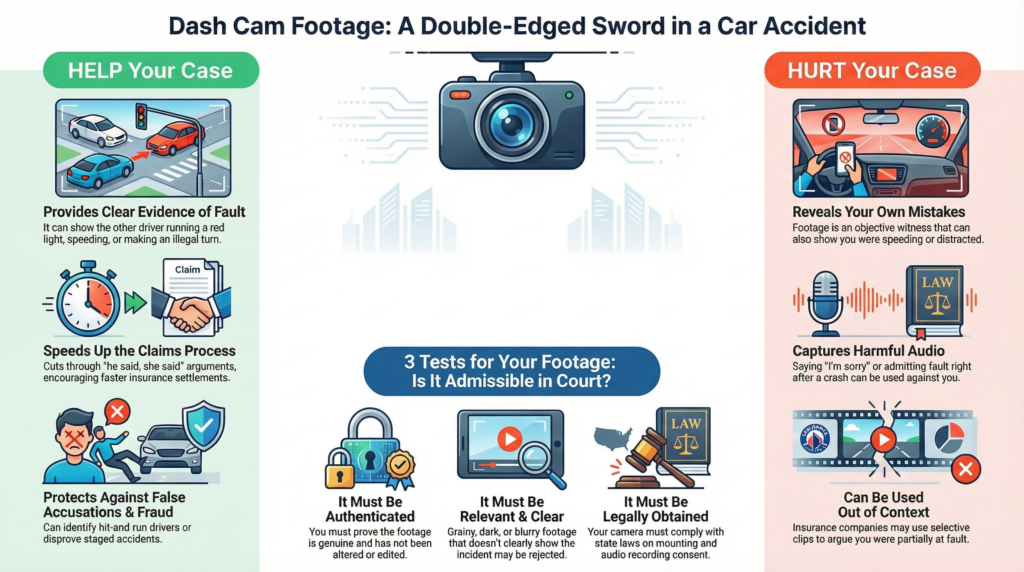
Dashcam footage can be powerful evidence after a car accident in Utah—but only if it is legally obtained, properly preserved, and reviewed by an experienced injury attorney.
How Dashcam Footage Can Help a Utah Injury Claim
When favorable, dashcam footage may clearly show:
- A driver running a red light or stop sign
- Failure to yield or improper turns
- Distracted driving, including phone use
- Aggressive behavior such as tailgating or road rage
- Weather or road hazards contributing to the crash
In many car accident in Utah cases, dashcam footage eliminates “he said, she said” disputes and forces insurers to accept responsibility earlier in the claims process.
How Dashcam Footage Can Hurt a Claim
At the same time, dashcam footage may reveal:
- Speeding or rolling through stop signs
- Following too closely
- Distracted driving by the injured party
- Audio statements insurers attempt to frame as admissions of fault
Because Utah follows a comparative fault system, even small mistakes captured on video can reduce compensation.
Utah’s Comparative Fault Rules and Dashcam Evidence
Utah applies a modified comparative negligence system under Utah Code § 78B-5-818.
- An injured person may recover damages only if they are less than 50% at fault
- Compensation is reduced by the injured person’s percentage of fault
- If fault reaches 50% or more, recovery is barred entirely
Dashcam footage often plays a decisive role in how fault is allocated after a car crash in Utah. Insurance companies regularly analyze footage frame by frame looking for evidence that shifts even partial blame.
Dashcam Footage in Insurance Negotiations
Most personal injury claims arising from a car accident in Utah resolve through settlement rather than trial. Dashcam footage can be extremely effective during negotiations, especially when liability is disputed.
Clear video evidence can:
- Speed up claim resolution
- Reduce disputes over fault
- Increase settlement leverage
- Discourage lowball offers
At the same time, insurers may attempt to cherry-pick moments from footage to argue shared fault. This is why dashcam footage should never be provided to an insurance company without legal review.
Best Dashcam Features for Utah Drivers in 2026
To maximize evidentiary value after a crash, dashcams should include:
- 1080p or higher resolution
- Wide-angle lens to capture multiple lanes
- Night or low-light recording
- G-sensor impact detection that locks files
- GPS speed and location tracking
What to Do With Dashcam Footage After a Car Accident in Utah
- Preserve the footage immediately before it is overwritten
- Back up the file to multiple secure locations
- Do not edit, trim, or annotate the video
- Avoid posting footage on social media
- Consult a car accident lawyer before sharing it
Even well-intentioned actions can damage a claim if evidence is mishandled.
How London Harker Uses Dashcam Evidence to Protect Clients
At London Harker, we understand how modern evidence shapes injury claims. Our attorneys know how to evaluate dashcam footage, preserve admissibility, counter comparative fault arguments, and use video evidence to maximize compensation.
If you were injured in a car accident in Utah, visit our Sandy car accident lawyer page to learn how we can help.
Final Thought
Your dashcam is a digital witness. When handled correctly, it can be one of the strongest tools available after a car crash in Utah. When mishandled, it can quietly undermine an otherwise valid claim. Before sharing footage with an insurance company, speak with an experienced Utah car accident attorney who understands how to use this evidence effectively.